What to Do When Makeup Oxidizes
Foundation that matched perfectly in the store mirror can turn orange, gray, or ashy a few hours into wear, so what should you actually do when makeup oxidizes, and is the common advice to just buy a shade lighter and let it darken any good?
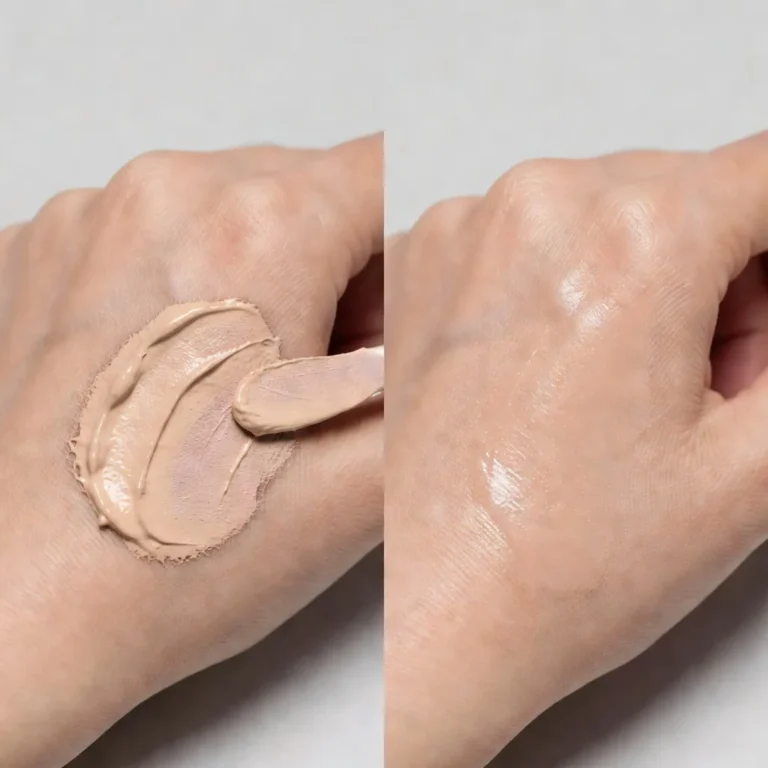
A Society of Cosmetic Chemists formulation study found the skin’s own sebum drives most of that color shift, while sweat and light exposure barely move the needle in comparison — a specific, quantified imbalance that most beauty advice glosses over. Calling the process “oxidation” is also something of a misnomer: the iron oxide pigments that give foundation its color are already chemically stable, so the visible shift is closer to an optical and physical interaction with skin oil than a true redox reaction.
A genuinely useful correction worth naming directly: buying foundation a shade too light on purpose so it “oxidizes to match” works against a mechanism that is driven by an individual person’s oil chemistry, not a predictable universal clock, which is exactly why that trick backfires unevenly from one person to the next.
This guide covers the real sebum-driven mechanism, why some skin types shift more than others, genuine prevention through primers and setting, and what to actually do once oxidation has already happened mid-wear.
Recommended Long-Wear Foundations Formulated to Resist Oxidation
Key Takeaways
- Sebum, not oxygen exposure, is the dominant force behind color-shifting foundation, according to spectrophotometer testing from the Society of Cosmetic Chemists.
- The pigments in most foundations are iron oxides, which are already fully oxidized, stable minerals — so “oxidation” is a misleading name for what is really an optical and physical shift.
- Buying a shade too light on purpose so it “oxidizes into place” backfires, because the shift is not uniform across the face or predictable over time.
- Blotting oil and color-correcting a small zone works better than reapplying a full layer of foundation on top of skin that has already shifted underneath.
Jump to a Section
- What Actually Happens When Foundation Changes Color
- Why “Oxidation” Is Mostly the Wrong Word
- The Data Behind the Sebum Explanation
- How the Shift Differs by Skin Type
- Why Buying a Lighter Shade on Purpose Backfires
- Prevention Starts Before You Open the Bottle
- Product and Primer Choices That Help
- How Brands Engineer Formulas to Resist the Shift
- Fixing It Once It Has Already Happened
- Do’s and Don’ts at a Glance
- A Routine for Correcting Oxidized Areas Midday
- This Is an Actively Studied Problem
- Frequently Asked Questions
- Bottom Line
What Actually Happens When Foundation Changes Color
Most people notice it by mid-afternoon: foundation that looked well-matched at 8 a.m. has turned orange, gray, or ashy by lunch. The popular explanation is “oxidation,” as though makeup reacts with air the way a cut apple browns. A formal study from the Society of Cosmetic Chemists (SCC) tested this directly rather than assuming it, and the results point somewhere else.
The SCC applied liquid foundation to artificial leather with an automatic coating machine, then isolated three variables blamed for color shift — artificial sebum, artificial sweat, and UV/sunlight exposure — testing each separately and measuring brightness change (delta-L in the L*a*b color system) with a spectrophotometer, across nine measurement points and a wide range of pigment and filler-powder types.
Why “Oxidation” Is Mostly the Wrong Word
Before getting into what does cause the shift, it is worth being honest about what almost certainly does not. Iron oxides — the yellow, red, and black pigments used in most foundation formulas — are already fully oxidized, stable mineral compounds, not waiting to react further with oxygen. As the formulation resource Siloran puts it, “the darkening seen during wear should not be attributed to a simple oxidation reaction of the iron oxides themselves.”
Some sources further break the popular “oxidation” label into three distinct things people lump together: a genuine iron-oxide-and-oxygen reaction (real, but minor), an acid-mantle or pH reaction (not oxidation at all), and oil physically mixing into the product (a physical blend, not a chemical reaction). The umbrella term survives as a convenient shorthand, not because it describes the dominant mechanism accurately.
The Data Behind the Sebum Explanation
Here is the underused finding worth remembering: the SCC’s data found artificial sebum produced a brightness shift of -1 to -6, while both artificial sweat and light exposure stayed within -1 — essentially negligible by comparison. Most consumer advice treats sweat, humidity, and light as roughly equal contributors alongside oil. The measured data says oil does nearly all of the work.
| Factor Tested | Brightness Shift (delta-L) | What That Means |
|---|---|---|
| Artificial sebum (130 microliters, dried 24 hours) | -1 to -6 | The dominant driver of visible darkening |
| Artificial sweat (15-minute immersion, dried 24 hours) | Within -1 | Essentially negligible on its own |
| UV/sunlight exposure (24 hours) | Within -1 | Essentially negligible on its own |
This matters practically: if sweat and light barely move the needle, chasing “sweat-proof” formulas or avoiding sunlight will not meaningfully prevent the shift. Managing skin oil is where the real leverage is.
How the Shift Differs by Skin Type
A skin-type breakdown from chemistry-forward beauty writing is consistent with the sebum-dominance finding above, though no sample size or formal methodology backs it — treat it as reasonable synthesis, not a cited statistic.
| Skin Type | Typical Pattern | Why |
|---|---|---|
| Oily | Fastest shift, often noticeable within 2 to 4 hours, concentrated in the T-zone | Matches the highest sebum output |
| Dry | Minimal color shift, but foundation clings to flaky patches instead | Low sebum changes how the product fails, not whether it fails |
| Combination | Center of the face shifts while cheeks stay accurate, reading as patchy mismatch | Uneven sebum distribution across the face |
Why Buying a Lighter Shade on Purpose Backfires
A piece of advice repeated across beauty sites is to buy a shade slightly too light, on the theory that it will “oxidize into place.” None of the sources repeating this advice offer a formal citation, but the reasoning against it follows directly from the mechanism above, and it is sound. The shift is not uniform: sebum output varies by facial zone and by hour, so a too-light shade darkens fastest where sebum is highest and barely shifts where it is lower, producing patchiness rather than a clean match.
It is also not a fixed offset: a shade “caught up” by noon can overshoot by evening, especially in heat, since warmer conditions plausibly accelerate the same reaction — a reasonable inference, not a separately tested fact. It guarantees a mismatched face for the first several hours of wear, defeating the point of shade matching, since pigment-matching is engineered to be accurate at purchase, not corrected after the fact.
Prevention Starts Before You Open the Bottle
Monika Blunder, a Los Angeles-based celebrity makeup artist and founder of Monika Blunder Beauty, outlines prevention habits that line up with the sebum-driven explanation above. Cleanse and exfoliate thoroughly before applying foundation — genuinely clean skin is the real starting point. Use lighter-weight moisturizers so excess oil is not sitting under the foundation layer, and let skincare fully absorb before makeup goes on top of it.
Clean makeup tools and sponges regularly, since bacterial buildup can itself contribute to color shift, independent of skin oil. And sample-test a foundation on your own skin before buying it, since sebum composition and pH vary person to person in ways a shade description cannot predict.
Product and Primer Choices That Help
If a particular foundation reliably shifts color on your skin, formula choice matters more than technique. Look for lower-iron-oxide or “non-oxidizing” labeled formulas if this is a recurring problem.
How Brands Engineer Formulas to Resist the Shift
On the manufacturing side, a few techniques explain why some foundations are marketed as darkening-resistant. Silicone-surface-treated pigments reduce sebum’s direct contact with the raw pigment. Chelating agents such as disodium EDTA bind trace metal ions that can otherwise promote genuine oxidative reactions. Antioxidants like vitamin E protect the formula’s oil phase, though they do not fully prevent the shift caused by skin’s own sebum. Oil-absorbing silica and film-forming technology create a physical barrier between skin oil and the pigment layer above it.
Fixing It Once It Has Already Happened
When color shift shows up mid-wear, the order of operations matters. Blot oil first, using paper rather than more powder — adding pigment onto an oil-saturated area compounds the problem. A small amount of lightweight, oil-absorbing powder, pressed rather than swiped, can reset the surface before touching up.
If a foundation reliably shifts within a few hours on your skin, treat that as diagnostic information rather than bad luck: your sebum output or pH is likely incompatible with that formula, and the durable fix is a different formula, not a better touch-up technique.
Do’s and Don’ts at a Glance
Do
- Clean makeup sponges and brushes on a regular schedule.
- Use a lightweight moisturizer and let it fully absorb before foundation.
- Apply an oil-free, silicone-based primer if you know your skin runs oily.
Don’t
- Buy a shade lighter than your actual match expecting it to “oxidize into place.”
- Layer more of the original foundation directly on top of an already-shifted zone.
- Assume sweat-proof or long-wear marketing addresses the real cause, which is sebum.
A Routine for Correcting Oxidized Areas Midday
Blot, don’t powder
Press a blotting paper against the shifted area to lift surface oil before doing anything else to it.
Assess the zone
Check whether the shift is confined to the T-zone or spread more broadly, which tells you how much correction is needed.
Apply a minimal corrector
Use a small amount of cooler-toned concealer only where the shift is visible, rather than reapplying foundation over the whole area.
Set lightly
Press, rather than swipe, a small amount of oil-absorbing powder into the corrected zone.
Note the pattern
If the same zone shifts again within a few hours, treat that as a sign to change your formula, not to touch up more often.
This Is an Actively Studied Problem
This is not just internet folklore. Peer-reviewed researchers have studied foundation darkening directly, including a 2023 paper in Skin Research and Technology on the mechanism behind it, and separate 2024 and 2025 papers in the International Journal of Cosmetic Science investigating sebum’s role. Full-text access was blocked during research for this article, so no statistics from those papers are quoted here — but their existence confirms this is an actively studied, mechanistic phenomenon, not guesswork.
Frequently Asked Questions
Is foundation oxidation actually a chemical reaction?
Mostly no; iron oxide pigments are already stable, fully oxidized minerals, so most of the shift is sebum changing how light interacts with the pigment film rather than a fresh chemical reaction.
What causes foundation to change color the most?
Skin sebum, according to spectrophotometer testing from the Society of Cosmetic Chemists that found sebum caused a far larger shift than sweat or light exposure.
Should I buy a lighter foundation shade so it darkens to match?
No; the shift is uneven across the face and changes over time, so this creates patchiness rather than a clean match.
Does oily skin oxidize faster than dry skin?
Yes, oily skin typically shows the fastest, most noticeable shift, especially in the T-zone, consistent with sebum being the dominant driver.
Can primer prevent the color shift?
An oil-free, silicone-based primer reduces how much sebum contacts pigment directly, making it one of the more evidence-consistent prevention steps.
Is it safe to keep adding foundation over a shifted area?
Layering more of the original shade over an already-shifted zone usually makes the mismatch more visible instead of fixing it.
Do “non-oxidizing” foundations really work differently?
Yes; they typically rely on silicone-treated pigments, chelating agents, or oil-absorbing powders to reduce how sebum interacts with pigment.
Does sweat or humidity really change foundation color?
Industry spectrophotometer data found sweat and light exposure each caused only a within-one-point shift, far smaller than sebum’s measured effect.
How long does it usually take for the shift to show up?
Skin-type breakdowns describe oily skin shifting within 2 to 4 hours, though timing varies by individual skin chemistry and formula.
Do dirty makeup sponges really contribute to color shift?
Yes; a makeup artist source notes bacterial buildup on unwashed tools and sponges can itself contribute to color shift, separate from sebum.
Bottom Line
Calling this phenomenon “oxidation” is a convenient shorthand, not an accurate description of the chemistry — the pigments involved are already stable, and the measured driver is sebum changing how light interacts with the foundation film, not oxygen exposure. That reframing has practical consequences: prevention should focus on managing oil rather than chasing sweat-resistance or avoiding sunlight, and mid-wear fixes work better as targeted, minimal corrections than as another full layer of the original shade.
This is a genuinely studied, mechanistic problem with a specific, quantified cause. Treat shortcuts like “buy it lighter and let it oxidize” as working against that mechanism rather than with it, and treat a foundation that reliably shifts within hours as a formula-compatibility signal worth acting on.