
Microdermabrasion Facial: What the Evidence Shows
A microdermabrasion facial gets sold as a gentle, all-purpose fix for texture, fine lines, and even acne scars, and the real clinical evidence is more specific and more modest than that pitch.
The most substantial histological study on record, 38 patients across four groups given 8 weekly sessions, found a genuine increase in collagen fiber organization, but no significant change in elastic fibers and only “mainly mild” improvement for photoaging. Motorized microdermabrasion devices are also Class I, exempt from FDA premarket review since 1998, a much lower regulatory bar than most people assume “FDA-cleared” implies.
Crystal, diamond-tip, and hydro systems all reach roughly the same depth using different delivery methods, and a specific, rarely-mentioned occupational exposure history is part of why the industry shifted toward diamond-tip and hydro systems over time.
This guide covers what the real histology shows, the precise FDA classification most articles get wrong, honest limitations around scars and wrinkles, and a one-minute check for whether you should even book a session this week.
Recommended Products for At-Home Exfoliation
Key Takeaways
- Microdermabrasion abrades the stratum corneum and upper epidermis using crystal, diamond-tip, or hydro (fluid-infusion) systems, all working through physical exfoliation, not a chemical reaction.
- Motorized microdermabrasion devices are classified by the FDA as Class I, exempt from premarket 510(k) review since 1998, a lower regulatory bar than most consumers assume “FDA-cleared” implies.
- The best available histological study (38 patients, 8 sessions) found microdermabrasion genuinely improves collagen fiber organization but produces no significant change in elastic fibers or epidermal thickness.
- It cannot resolve deep acne scars or meaningfully reduce wrinkles; both key clinical studies describe the effect on photoaging as “mainly mild.”
- Crystal systems carry a specific, rarely-mentioned occupational exposure history that helped push the industry toward diamond-tip and hydro alternatives.
- A simple pre-session mirror check for active inflammatory acne tells you in under a minute whether you should book a session at all.
Table of Contents
- What Microdermabrasion Actually Does to Skin
- Crystal vs. Diamond-Tip vs. Hydro Systems
- What the Clinical Evidence Actually Shows
- The FDA Classification Almost No One States Correctly
- Microdermabrasion vs. Chemical Peels
- Do This, Not That
- What a Session Actually Involves
- One-Minute Check Before You Book
- Why the Industry Moved Away from Crystal
- Who Should Skip It
- Aftercare and Sun Sensitivity
- When to See a Dermatologist
- Frequently Asked Questions
- The Bottom Line
What Microdermabrasion Actually Does to Skin
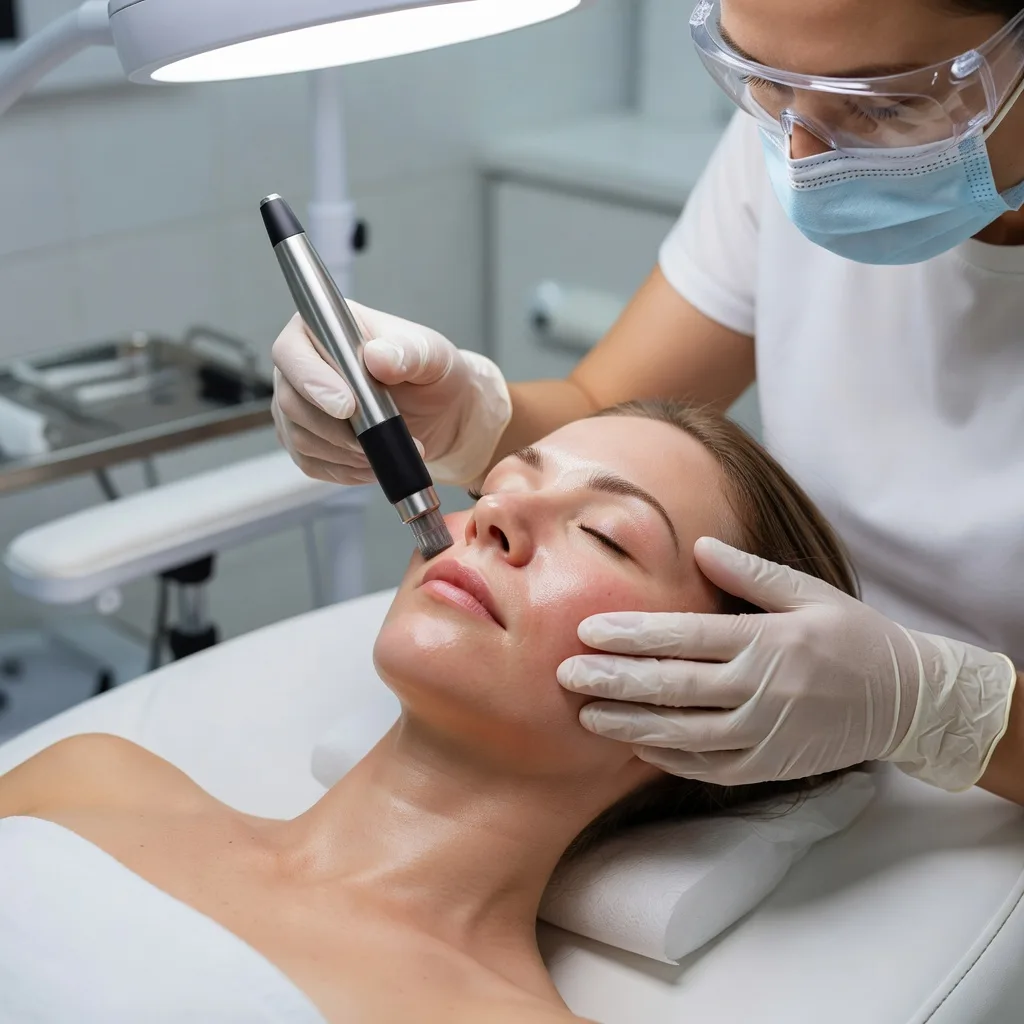
Microdermabrasion is mechanical exfoliation, physically abrading the outermost dead-cell layer of skin under vacuum suction that removes the debris as it’s created. Nothing about it is chemical: there’s no acid, no enzyme, no pH-driven reaction, just controlled physical contact against the stratum corneum and, with more aggressive or repeated treatment, the upper epidermis just beneath it.
That distinction matters because “microdermabrasion” gets used loosely alongside chemical peels and other resurfacing categories as if they’re interchangeable. They aren’t. The depth reached, the mechanism of action, and the realistic outcomes all differ, and conflating them is where a lot of the overselling in this category starts.
Crystal vs. Diamond-Tip vs. Hydro Systems
Three delivery systems dominate the category, and they’re mechanically distinct even though they’re marketed as near-equivalent.
| System | How It Abrades | Practical Notes |
|---|---|---|
| Crystal (aluminum oxide or sodium bicarbonate) | Loose crystals blasted across skin under suction | Messier, requires eye/airway protection for both client and esthetician |
| Diamond-tip | Abrasive diamond-dust-coated wand tip, no loose media | More controllable, has largely displaced crystal in professional settings |
| Hydrodermabrasion | Abrasion combined with simultaneous fluid/serum infusion and suction | Marketed as gentler for sensitive skin; newer category with less independent long-term study |
All three reach roughly the same depth. The differences are mostly about mess, control, and comfort, not about a fundamentally different result underneath.
What the Clinical Evidence Actually Shows
The most substantive study on record is a 2016 Journal of Cosmetic Dermatology paper by El-Domyati and colleagues: 38 patients split into four groups (melasma, acne scars, striae distensae, and photoaging), each given a series of 8 microdermabrasion treatments one week apart, with skin biopsies taken at baseline, after the 4th session, and after the 8th.
The histology found a genuine increase in collagen fiber density with more regular bundle arrangement in the acne scar, striae, and photoaging groups, real evidence of some dermal remodeling, not just surface polish. But orcein staining showed no significant change in elastic fibers in any group, and epidermal thickness changes weren’t statistically significant either. For the photoaging group specifically, the paper describes clinical improvement as “mainly mild.” The authors’ own conclusion: microdermabrasion is easy and safe, producing “mild to moderate improvement,” a precisely worded, honest summary that avoids both overselling and dismissing the treatment.
An earlier, smaller 2001 study (14 patients, 3 with paired biopsies, treated over 12 to 14 weeks) found statistically significant patient-reported improvement in roughness, pigmentation irregularities, and overall appearance, along with epidermal hyperplasia and decreased melanization on histology. Interestingly, that earlier study found some increase in elastin, which doesn’t fully match the larger 2016 study’s null elastin finding, a genuine inconsistency in the literature worth flagging rather than smoothing over. Both studies agreed on one thing: effectiveness for wrinkles was limited, and results for acne scars were inconsistent, since meaningful scar correction typically needs deeper treatment than standard microdermabrasion depth reaches.
Both key studies are small, 14 to 38 patients, non-randomized, and without a sham-treatment control arm. That’s legitimate preliminary clinical and histological evidence, not randomized-controlled-trial-level proof of outcome magnitude the way retinoid or laser literature has behind it.
The FDA Classification Almost No One States Correctly
Worth knowing: manual dermabrasion devices are classified under 21 CFR 878.4800 as Class I, and motorized/powered dermabrasion devices, the relevant category for most professional microdermabrasion machines, fall under 21 CFR 878.4820, also Class I, exempt from 510(k) premarket notification since February 1998.
Class I, 510(k)-exempt status means the FDA does not require premarket clinical evidence of efficacy for the base device category. A manufacturer only needs a new submission if the device is used for a genuinely new indication or a materially different technology than existing predicate devices. That’s a meaningfully lower regulatory bar than something like an RF or laser device, and it’s a specific, checkable fact that most competing articles skip entirely, usually settling for a vague “FDA approved” that isn’t even accurate phrasing for an exempt Class I device.
Microdermabrasion vs. Chemical Peels
| Factor | Microdermabrasion | Chemical Peel |
|---|---|---|
| Mechanism | Physical/mechanical abrasion | Controlled chemical keratolysis |
| Depth | Stratum corneum, upper epidermis | Varies by strength: superficial peels are comparably shallow; medium-depth peels (e.g. TCA) go deeper |
| Downtime | Minimal to none | None to several days, depending on peel strength |
“It’s basically the same as a peel” is partly true and partly an oversimplification. Both exfoliate, but a low-strength glycolic or salicylic peel and microdermabrasion land at similar depths, while a medium-depth peel goes further than microdermabrasion typically reaches. Which one is “equivalent” depends entirely on which specific peel you’re comparing it to.
Do This, Not That
Do
- Book a series of sessions rather than expecting one to change texture meaningfully
- Ask whether the provider uses crystal, diamond-tip, or hydro, and why
- Wear strict SPF for several days afterward
Don’t
- Expect it to resolve deep acne scars or significant wrinkles
- Book a session over active, inflamed, or pustular acne
- Assume “FDA-cleared” means the specific results claim was clinically proven
What a Session Actually Involves
Cleanse and analyze
The esthetician double-cleanses skin and assesses tone, texture, and any contraindications before starting.Abrade under suction
The crystal, diamond, or hydro handpiece passes across skin in controlled strokes while vacuum suction lifts away exfoliated debris.Extractions if needed
Any accessible, non-inflamed congestion may be cleared manually at this stage.Calm and protect
A soothing mask or serum is applied, followed by moisturizer and broad-spectrum SPF before you leave.
One-Minute Check Before You Book
Worth trying: look at your skin under bright light right before a scheduled session. If you see any red, swollen, or pus-filled bumps, active cystic or pustular acne, reschedule. Mechanical abrasion over active inflammatory lesions risks spreading bacteria across the treated area and worsening the breakout, a real, defensible reason to wait rather than a generic caution.
Why the Industry Moved Away from Crystal
Crystal systems carry a specific, rarely-cited history: early aluminum oxide crystal setups raised occupational exposure concerns for the treating esthetician, who faced repeated inhalation exposure to loose particulate over the course of a working day, not just the client in a single session. That occupational safety concern, alongside the practical mess of loose crystals needing thorough cleanup and the risk of stray particulate reaching the eyes without careful masking, is a real, practical part of why diamond-tip and hydro systems have gained favor in professional settings over time, a “why” that’s usually missing from generic crystal-vs-diamond comparison content.
Who Should Skip It
Real risk to flag: microdermabrasion isn’t appropriate over active or severe (pustular, cystic) acne, active cold sores or herpes simplex outbreaks, rosacea flares, or very thin, fragile skin, such as from isotretinoin use or certain connective tissue conditions. Mechanical abrasion in any of these states risks worsening inflammation, spreading infection, or leaving lasting marks.
Aftercare and Sun Sensitivity
Freshly treated skin has a thinner, more UV-vulnerable stratum corneum for several days afterward, so strict SPF and sun avoidance immediately post-treatment is a specific, non-generic safety point, not just a blanket “wear sunscreen” reminder. The same underlying skin-barrier logic applies to any exfoliating treatment, including a de-tan facial, where post-treatment sun exposure can undercut the entire point of the session.
When to See a Dermatologist
See a dermatologist or skin specialist rather than booking another spa session if you have deep or widespread acne scarring, if a treated area shows unusual, persistent redness or pigment change, or if you’re unsure whether a mark you’re trying to treat is superficial texture or something structural that microdermabrasion physically cannot reach.
Frequently Asked Questions
What is a microdermabrasion facial?
A mechanical exfoliation treatment that physically abrades the outer dead-skin layer using crystal, diamond-tip, or hydro (fluid-infusion) systems, removing debris under vacuum suction.
Is microdermabrasion FDA-approved?
Motorized microdermabrasion devices are Class I and exempt from FDA premarket review since 1998, a lower bar than most people assume “FDA-cleared” implies.
Does microdermabrasion remove acne scars?
Not reliably; clinical studies found inconsistent results for scars, since meaningful correction typically needs deeper treatment than standard microdermabrasion reaches.
Does it reduce wrinkles?
Only mildly at best; the strongest available studies describe the effect on photoaging as “mainly mild” with no significant change in elastic fibers.
Is diamond-tip better than crystal microdermabrasion?
Mechanistically similar, but diamond-tip avoids the loose-particulate mess and occupational exposure concerns that pushed the industry away from crystal systems.
Is it the same as a chemical peel?
Not exactly; it’s physical abrasion rather than chemical keratolysis, and it lands at a depth comparable to a low-strength peel but shallower than a medium-depth peel.
Who should avoid microdermabrasion?
Anyone with active or severe acne, active cold sores, rosacea flares, or very thin, fragile skin from isotretinoin or certain connective tissue conditions.
How many sessions does it take to see a difference?
Clinical studies used series of multiple sessions, roughly weekly, rather than a single treatment, to show measurable histological change.
Does it help with hyperpigmentation?
It can speed the appearance of fading by exfoliating already-pigmented surface cells faster, but it doesn’t stop new pigment production the way a tyrosinase-inhibiting active does.
What should I do after a session?
Apply strict broad-spectrum SPF and avoid direct sun exposure for several days, since freshly treated skin has a thinner, more UV-vulnerable outer layer.
The Bottom Line
Microdermabrasion is a real, well-documented mechanical exfoliation treatment with genuine, if modest, histological evidence behind it: it improves collagen organization without meaningfully rebuilding elastin, and it’s classified by the FDA as a low-oversight, premarket-exempt device category rather than something independently proven effective at the marketed claim level.
Used with realistic expectations, as a texture and mild-pigmentation maintenance treatment rather than a fix for deep scars or real wrinkles, and skipped during active inflammatory flares, it’s a low-risk, well-understood option. Treating it as a substitute for scar revision, deep resurfacing, or dermatologist-guided pigment treatment is where the marketing outruns the evidence.


One Comment