Microdermabrasion for Acne and Blackheads: Real Answer
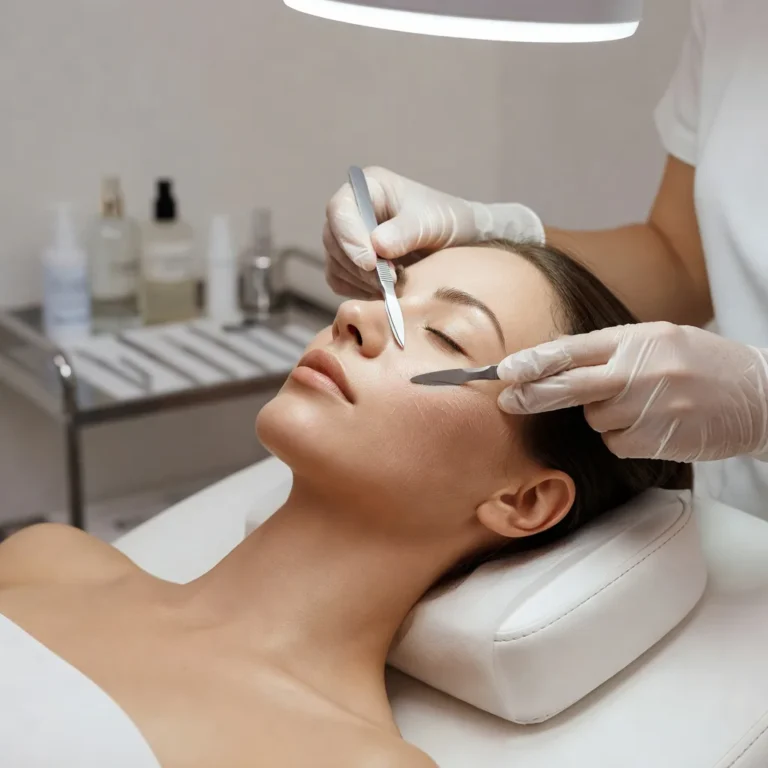
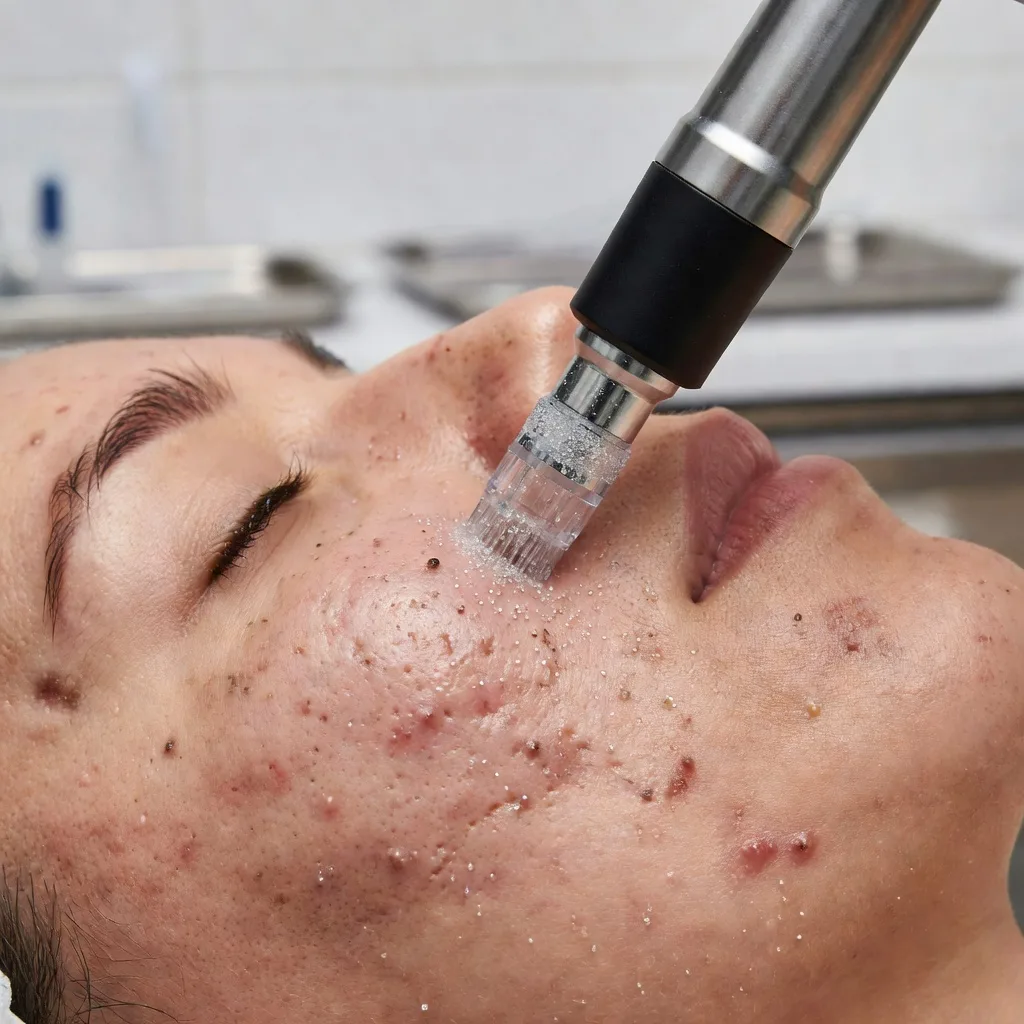
Microdermabrasion for acne and blackheads is a common recommendation at spas and skin clinics, but the evidence behind it is more limited than the marketing suggests.
Microdermabrasion only removes the outermost third of the skin’s dead surface layer, while comedones and inflammatory acne both form deeper than that reach, which is the core reason mainstream dermatology doesn’t support it as an acne treatment. A small 2022 trial did find real benefit, but it used a fundamentally different saline-and-oxygen device, not standard crystal or diamond-tip microdermabrasion.
Blackheads and whiteheads are at least partially surface-accessible, while inflammatory papules, pustules, nodules, and cysts sit well below where mechanical exfoliation can safely reach.
This guide covers what the treatment can and can’t realistically do, and how to tell which lesions are safe to treat at all.
Recommended Salicylic Acid Treatments for Blackheads
Why Microdermabrasion Can’t Reach the Actual Clog
Microdermabrasion only removes the top third or so of the stratum corneum — the thin, dead outermost layer of skin. Comedones, the technical term for both blackheads and whiteheads, form deeper than that, inside the hair follicle itself. That depth mismatch is the core reason mainstream dermatology doesn’t support microdermabrasion as an acne treatment: per a detailed evidence review from acne.org, microdermabrasion “cannot unclog pores, which originate in deeper layers of the skin.” It’s a mechanism problem, not a matter of the treatment simply being too gentle or needing more sessions — the tool physically doesn’t reach where the actual clog sits.
One frequently cited older study, from 2001, claimed a benefit for acne, but a peer reviewer examining it flagged it as methodologically “completely meaningless,” because participants were using acne medications at the same time as microdermabrasion, making it impossible to separate out what was actually causing any improvement seen.
What You Should Know
- Microdermabrasion only reaches the top third of the outer skin layer, while comedones form deeper, inside the follicle itself.
- One small, well-designed 2022 trial did show a real benefit for acne — but it used a fundamentally different device, not standard microdermabrasion.
- Blackheads and whiteheads are at least partially surface-accessible, unlike inflammatory papules, pustules, nodules, or cysts.
- The AAD directly warns against mechanically scrubbing or manipulating active acne lesions, independent of microdermabrasion specifically.
- The traditional “wait 6 months after isotretinoin” rule is more conservative than current evidence supports for superficial procedures, though caution still applies to more aggressive mechanical dermabrasion.
- Post-inflammatory hyperpigmentation is a real risk in anyone prone to dark marks after breakouts.
Browse Sections
- Why Microdermabrasion Can’t Reach the Actual Clog
- The One Study That Did Show Benefit
- Blackheads and Whiteheads vs. Inflammatory Acne
- Why It Can Make Active Acne Worse
- The Isotretinoin Timing Nuance
- If You’re Treating Blackheads Specifically
- Who Might See Some Benefit
- Who Should Skip It Entirely
- When to See a Dermatologist Instead
- A One-Minute Lesion Check
- Where the Evidence Runs Out
- Frequently Asked Questions
The One Study That Did Show Benefit
There is a genuinely interesting, counterintuitive finding here worth stating honestly: a small 2022 randomized, placebo-controlled trial published in the Journal of Clinical Medicine did find a real benefit for mild acne — but it tested “oxybrasion,” not standard crystal or diamond-tip microdermabrasion. Oxybrasion uses a pressurized 0.9% saline stream combined with oxygen delivery, a genuinely different device category. In the trial, 24 women aged 19 to 21 with mild acne (a mix of blackheads, whiteheads, and inflammatory papules) were randomized to active treatment or placebo. The active group showed a statistically significant improvement in Global Acne Grading System score, plus improved hydration and reduced sebum, with no reported side effects; the placebo group showed minimal change.
The study’s own authors call it a preliminary report with a limited sample and explicitly call for larger, more diverse trials, including male participants. The honest takeaway: device type matters enormously here, and the one positive trial in this space isn’t testing what a standard spa “microdermabrasion facial” actually is.
Blackheads and Whiteheads vs. Inflammatory Acne
The distinction that actually determines whether microdermabrasion has any plausible effect at all is comedone type. Open comedones, or blackheads, and closed comedones, or whiteheads, are superficial plugs of keratin and sebum. A detailed review in the Indian Journal of Dermatology, Venereology and Leprology describes open comedones as showing “massive follicular dilation which opens to the epidermis” — meaning they’re at least partially accessible at the skin’s surface, which is the only real reason superficial mechanical exfoliation could plausibly have any effect on them at all.
Inflammatory acne — papules, pustules, nodules, and cysts — is a fundamentally different problem. It involves deeper follicular rupture and an active immune response well below where microdermabrasion reaches, which mechanical abrasion cannot meaningfully address, and can actively aggravate.
| Lesion type | Depth | Microdermabrasion’s plausible role |
|---|---|---|
| Blackheads / open comedones | Superficial, partially surface-accessible | Limited, mostly cosmetic surface effect |
| Whiteheads / closed comedones | Superficial, follicular | Limited effect; plug still largely below reach |
| Inflammatory papules/pustules/nodules/cysts | Deeper, with active immune involvement | None; mechanical treatment can worsen inflammation |
Why It Can Make Active Acne Worse
The AAD’s own consumer guidance is direct on this point, independent of microdermabrasion specifically: on blackheads, it advises to “resist scrubbing, it will only worsen your acne”; on pustules, “resist the temptation to pop these, it can worsen acne.” That guidance generalizes straightforwardly to microdermabrasion’s physical, abrasive action on inflamed lesions — mechanical irritation on already-inflamed skin can worsen redness and swelling, and shared device heads or crystal flow can spread acne-causing bacteria across the face during treatment.
The Isotretinoin Timing Nuance
The traditional rule — wait 6 months after finishing isotretinoin before any abrasive or resurfacing procedure — is worth a more precise look. A consensus review from the American Society for Dermatologic Surgery’s Guidelines Task Force examined this rule across procedures generally (lasers, peels, dermabrasion) and found that much of the original caution traces back to weak case-series evidence rather than controlled trials. Their conclusion: superficial, focal procedures carry low to very low risk even during or shortly after isotretinoin use, while full-face ablative laser resurfacing and mechanical dermabrasion using rotary devices still warrant the traditional 6-month wait. That’s a meaningful nuance — the blanket rule is more conservative than current evidence strictly requires for the gentlest procedures, but it still holds for more aggressive mechanical treatment specifically, which is closer to what standard microdermabrasion is.
| Concern | Evidence-based option | Where microdermabrasion fits |
|---|---|---|
| True blackheads/whiteheads | Topical retinoids, salicylic acid | Possible limited, temporary cosmetic add-on, not a replacement |
| Inflammatory acne (papules/pustules) | Benzoyl peroxide, prescription topicals or orals | Not appropriate; mechanical treatment can worsen inflammation |
| Mild acne, device-based option | Oxybrasion (saline + oxygen, per the 2022 trial) | A different device category entirely, not standard microdermabrasion |
If You’re Treating Blackheads Specifically
Confirm the lesion type first
Only proceed if the area is genuinely non-inflamed — flesh-toned or dark-tipped, flat, with no redness or tenderness.Avoid any active inflamed lesions nearby
Skip mechanical treatment over any red, swollen, or tender spot, even if it’s near an otherwise treatable area.Pair with, don’t replace, evidence-based topical treatment
Retinoids and salicylic acid have a stronger, more direct evidence base for comedones than mechanical exfoliation alone.Reassess after each session
If skin looks more irritated or breakouts increase rather than decrease, stop and consult a dermatologist.
Who Might See Some Benefit
People with purely superficial blackheads or whiteheads, with no active inflammatory acne present, are the group most likely to see any real cosmetic benefit, and even then the effect is limited and temporary rather than a genuine treatment for the underlying comedone-formation process. If you’re weighing this treatment for general skin texture and tone rather than acne specifically, our guide on how often to do microdermabrasion covers realistic scheduling for that broader use case.
Do
- Confirm you’re dealing with true blackheads or whiteheads, not inflamed acne, before treating
- Pair mechanical exfoliation with evidence-based topical acne treatment
- Ask about isotretinoin timing directly if you’ve used it recently
Don’t
- Expect microdermabrasion to clear inflammatory acne
- Treat over active papules, pustules, nodules, or cysts
- Assume the 2022 oxybrasion study result applies to standard crystal or diamond-tip devices
Who Should Skip It Entirely
Anyone with active moderate-to-severe inflammatory acne should skip microdermabrasion entirely rather than trying to work around specific lesions, since the risk of spreading bacteria and worsening inflammation across the face outweighs any plausible benefit to isolated blackheads. Recent isotretinoin use, active cold sores, and known aluminum-oxide-crystal allergies (for crystal-based devices specifically) are also reasons to skip or choose an alternative treatment.
When to See a Dermatologist Instead
If you have persistent inflammatory acne — papules, pustules, nodules, or cysts — a dermatologist can offer treatments with a real, direct evidence base for that specific problem, including topical retinoids, benzoyl peroxide, or prescription options, rather than a mechanical treatment that reaches the wrong depth. Also see a dermatologist if breakouts worsen after any at-home or professional exfoliating treatment, or if you’re unsure whether isotretinoin use in the past 6 months affects what procedures are currently safe for you.
A One-Minute Lesion Check
Before treating any spot mechanically, look closely at it. A flesh-toned or dark-tipped bump with no redness, swelling, warmth, or tenderness is a comedone — a true blackhead or whitehead — and superficial exfoliation over it carries relatively low risk. A lesion that’s red, swollen, warm, tender, or pus-filled is inflammatory, and mechanical exfoliation should be avoided over that specific area entirely. This is a real, clinically grounded distinction based on lesion morphology, not an invented test, and it’s the single most useful filter for deciding whether microdermabrasion has any plausible role at all in a given spot.
Where the Evidence Runs Out
Be precise about what’s actually established here: mainstream dermatology does not support standard microdermabrasion as an acne treatment, because of a genuine depth mismatch between what the tool reaches and where comedones and inflammatory lesions actually form. The one positive clinical trial used a different device entirely, was small and explicitly preliminary, and hasn’t been replicated at scale. The isotretinoin-timing nuance is real, but it favors caution specifically for mechanical dermabrasion, even as it loosens for gentler superficial procedures generally. Nothing here should be read as “microdermabrasion treats acne” — at best, it may offer a limited, temporary cosmetic effect on purely superficial blackheads and whiteheads in the absence of active inflammation.
Frequently Asked Questions
Does microdermabrasion actually clear acne?
No — mainstream evidence doesn’t support it, since the treatment only reaches the outer skin layer while acne and comedones form deeper.
Can it help with blackheads specifically?
It may offer a limited, temporary cosmetic effect on true blackheads since they’re partially surface-accessible, but it doesn’t address why they form.
Is there any real study showing benefit?
A small 2022 preliminary trial found benefit — but it used oxybrasion, a saline-and-oxygen device, not standard crystal or diamond-tip microdermabrasion.
Can microdermabrasion make acne worse?
Yes — mechanical irritation on inflamed lesions can worsen redness and swelling, and shared device surfaces can spread bacteria.
Is it safe to treat blackheads next to active pimples?
No — skip mechanical treatment over any red, swollen, or tender lesion, even if it’s near an area you’d otherwise treat.
How long after isotretinoin is microdermabrasion safe?
Traditional guidance says 6 months; current evidence suggests that’s conservative for gentle procedures but still reasonable caution for mechanical dermabrasion specifically.
What actually treats comedones effectively?
Topical retinoids and salicylic acid have a stronger, more direct evidence base for unclogging pores than mechanical exfoliation.
Can microdermabrasion cause dark spots after acne?
Repeated irritation can plausibly worsen post-inflammatory hyperpigmentation risk in anyone already prone to it.
How do I tell a blackhead from an inflamed pimple before treating it?
Flesh-toned or dark-tipped with no redness or tenderness is a comedone; red, swollen, warm, or pus-filled is inflammatory and should be avoided.
Should I see a dermatologist instead of trying microdermabrasion for acne?
Yes, for any persistent inflammatory acne — a dermatologist can offer treatments with a real evidence base at the correct depth.