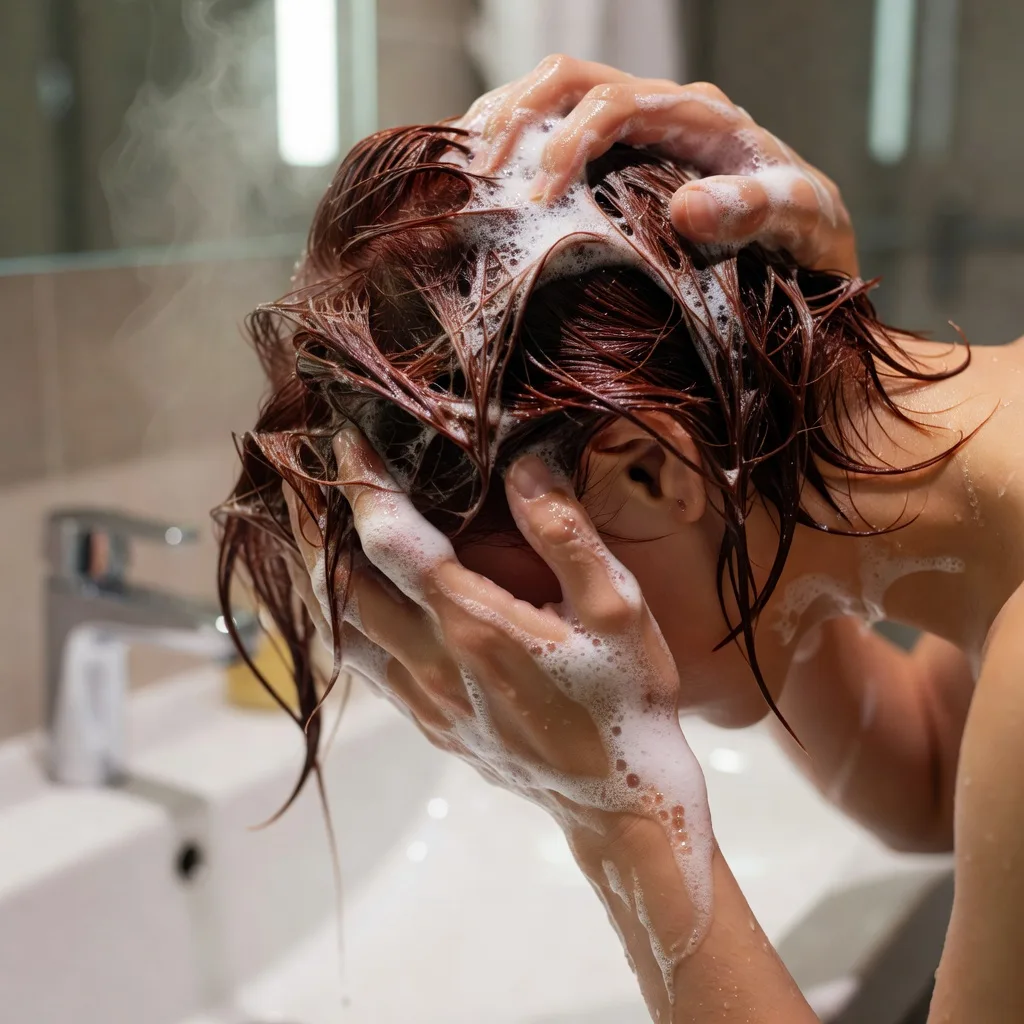
Can You Shampoo After Dying Hair?
Can you shampoo after dying hair right away, or is that the fastest way to undo a fresh color service?
Permanent hair dye keeps chemically developing inside the hair shaft for a period after it’s rinsed out, and professional guidance points to waiting a minimum of 48 hours before the first shampoo. Semi-permanent dye works differently and has a shorter minimum wait.
The popular claim that a cold-water rinse helps seal in color is a myth — cuticle behavior is driven mainly by a product’s pH, not water temperature, so an acidic conditioner does far more for retention than shower temperature ever could.
This guide covers the real chemistry behind why waiting matters, how long to actually wait by dye type, and which aftercare habits are backed by real cosmetic science versus which ones are just repeated folklore.
Recommended Sulfate-Free, Color-Safe Shampoos
The Bottom Line
- Permanent hair dye works through an oxidative reaction that keeps developing after the dye is rinsed out — washing too soon can undo color before that reaction and the hair’s cuticle fully close.
- Professional guidance points to a minimum 48-hour wait before the first shampoo, though this is industry best practice built on established chemistry, not a single clinical trial’s exact number.
- Semi-permanent dye works differently — it coats the hair surface rather than reacting inside it, so the main risk of washing early is simply rinsing off color that hasn’t settled yet.
- Sulfate-free shampoo is a mechanistically sound choice for color retention, since strong surfactants strip color-coating pigment faster than gentler ones.
- The popular claim that cold water “seals” color is a myth — cuticle behavior is driven mainly by a product’s pH, not water temperature.
Guide Outline
- The Real Chemistry of Permanent Hair Dye
- Why Waiting Actually Matters
- Semi-Permanent vs. Permanent: Different Timelines
- Wait Times By Dye Type
- Does Sulfate-Free Shampoo Really Help?
- Debunking the Cold-Water-Rinse Myth
- Myth vs. Mechanism, Side by Side
- Do’s and Don’ts
- Your First Wash After Coloring
- What Happens If You Wash Too Soon
- When to Ask Your Colorist Instead
- The Honest Limits of What We Know
- Frequently Asked Questions
The Real Chemistry of Permanent Hair Dye
Permanent hair dye works through a three-part oxidative reaction. First, an alkalizing agent — traditionally ammonia, or ethanolamine in “ammonia-free” formulas — raises the hair’s pH, causing the cuticle’s overlapping scales to lift and swell open. Second, hydrogen peroxide does two jobs at once: it bleaches the natural melanin pigment already in the hair’s cortex, and it acts as the oxidizing agent driving the dye chemistry itself. Third, small, colorless precursor molecules — most commonly para-phenylenediamine (PPD), or gentler alternatives in some formulas — penetrate the now-open cortex and react with coupler molecules, expanding into large, colored molecular complexes.
This same cuticle-lifting mechanism is part of why chemically treated hair, including color-treated hair, tends to be more porous and more prone to visible frizz or texture changes — a related chemistry covered in more depth in our piece on why chlorine affects hair texture, which walks through how cuticle damage from a different source (chlorine oxidation) produces a similar porosity effect.
The critical detail: those new color molecules are built inside the hair shaft, and once formed, they become too large to diffuse back out. That’s what makes the color genuinely “permanent” — but only once the reaction has fully finished and the cuticle has re-flattened enough to physically trap the pigment inside.
Why Waiting Actually Matters
Washing too soon works against color retention two ways at once: the cuticle hasn’t fully closed yet, so pigment complexes still near the surface can rinse out before they’re physically sealed in, and surfactant action can interfere with an oxidation reaction that’s still completing.
Semi-Permanent vs. Permanent: Different Timelines
Semi-permanent and demi-permanent dyes work through a genuinely different mechanism: direct dyes that coat the outer hair shaft and cuticle surface rather than penetrating and reacting inside the cortex. There’s no oxidative reaction building new trapped molecules, so there’s nothing chemically “completing” the way there is with permanent color. The main risk of washing too soon with semi-permanent dye is simply rinsing off surface-deposited pigment before it’s had time to settle — and because it’s not permanently bonded, it will fade progressively with every wash regardless of how carefully you time that first shampoo.
Wait Times By Dye Type
| Dye type | Mechanism | Typical minimum wait |
|---|---|---|
| Permanent (oxidative) | Reacts and forms trapped molecules inside the cortex | 48-72 hours |
| Demi-permanent | Partial oxidative reaction, shallower penetration | Around 24-48 hours |
| Semi-permanent (direct dye) | Coats the cuticle surface, no oxidation | 24 hours or per product label |
These ranges reflect professional and industry guidance rather than a single universally tested number, and individual product instructions should take priority when they differ.
Does Sulfate-Free Shampoo Really Help?
Sulfates like sodium lauryl sulfate are strong anionic surfactants — effective cleansers precisely because they strip oils and residue aggressively. That same aggressive action is disruptive to surface-deposited color molecules, particularly for semi-permanent dye sitting on or near the cuticle surface, and can accelerate fading. Sulfate-free surfactant systems clean more gently, causing comparatively less color-stripping per wash.
It’s worth being honest about the evidence tier here: this is a mechanistically sound, widely accepted principle in cosmetic chemistry, but it’s backed mainly by industry testing and surfactant-strength principles rather than a wealth of independent, peer-reviewed trials measuring exact colorimeter fade rates between sulfate and sulfate-free shampoos. The mechanism is solid; the specific magnitude of the difference is less rigorously quantified in independent literature.
Debunking the Cold-Water-Rinse Myth
The claim that cold water “seals” hair color is one of the most repeated pieces of hair-care advice — and it doesn’t hold up under the actual chemistry. Cuticle opening and closing is driven primarily by pH, not temperature. Alkaline products, including most shampoos, lift and open cuticle scales for cleansing. Acidic products — conditioners, gloss treatments, or a diluted acidic rinse — chemically flatten cuticle scales back down, which is what genuinely improves shine and slows color loss.
Myth vs. Mechanism, Side by Side
| Claim | What actually drives it |
|---|---|
| “Cold water seals in color” | Water of any temperature causes mild cuticle swelling; temperature isn’t the real lever |
| “Acidic rinse improves shine and color retention” | Correct mechanism — acidic pH flattens the cuticle |
| “Sulfate-free shampoo fades color slower” | Correct mechanism, though independent trial data is limited |
| “Waiting 48 hours protects permanent color” | Correct mechanism — gives the oxidation reaction and cuticle time to finish and close |
Do’s and Don’ts
Do
- Wait at least 48 hours before the first shampoo after permanent color
- Switch to a sulfate-free, color-safe shampoo for ongoing washes
- Use an acidic conditioner or gloss treatment to help the cuticle lie flat
Don’t
- Assume cold water alone will meaningfully protect your color
- Wash the same day as a permanent color service unless your colorist says otherwise
- Use a heavily clarifying or sulfate-heavy shampoo in the days right after coloring
Your First Wash After Coloring
Wait at least 48 hours
Give the oxidation reaction and cuticle time to fully complete and close before introducing any surfactant.Use lukewarm, not hot, water
Very hot water can be more aggressive on the cuticle and cause more fading over time, independent of the cold-water myth addressed above.Choose a sulfate-free, color-safe shampoo
Gentler surfactants reduce how much color-stripping happens per wash.Follow with an acidic conditioner
This is the step that actually helps flatten the cuticle and lock in shine and color.Space out washes going forward
Fewer washes per week generally means slower cumulative color fade, regardless of dye type.
What Happens If You Wash Too Soon
When to Ask Your Colorist Instead
Wait-time guidance can vary by specific product line, porosity of your hair, and whether you had a single-process color or a more complex service like highlights or balayage. Your colorist has the most accurate, product-specific answer for your exact service, and it’s worth asking directly rather than defaulting to a generic online number, especially for high-maintenance color like fashion shades or high-lift blonde.
The Honest Limits of What We Know
Much of the specific timing and shampoo guidance here comes from professional hair-color industry consensus built on established cosmetic chemistry, rather than dedicated peer-reviewed clinical trials measuring exact fade curves by wait time or surfactant type. The underlying chemistry — oxidation, cuticle behavior, pH effects — is well established; the precise numbers (48 hours, sulfate-free’s exact fade-rate advantage) are professional best practice rather than laboratory-measured thresholds.
Hair porosity, prior chemical treatment history, and water hardness in your specific home can all affect how quickly color actually fades regardless of how carefully the wait-time and shampoo guidance is followed — two people using an identical dye and identical aftercare routine can still see meaningfully different fade timelines because of these underlying differences in the hair itself.
Frequently Asked Questions
How long should I wait to shampoo after dying my hair?
Professional guidance points to a minimum of 48 hours for permanent color, with shorter windows sometimes cited for semi-permanent dye.
Does cold water really help hair color last longer?
Not meaningfully — cuticle behavior is driven mainly by a product’s pH, not water temperature, making the cold-water-seals-color claim a myth.
Is sulfate-free shampoo actually better for colored hair?
Yes, mechanistically — sulfates are stronger surfactants that strip color-coating pigment faster than gentler, sulfate-free formulas.
What happens if I wash my hair too soon after coloring?
You risk stripping color before the oxidation reaction and cuticle have fully closed, often leading to faster fading and duller results.
Do semi-permanent dyes need the same wait time as permanent dyes?
No — semi-permanent dye coats the hair surface rather than reacting inside it, so the wait time is generally shorter, though color still fades with each wash regardless.
Why does permanent hair dye need time to “set”?
The oxidation reaction that builds the color molecules inside the hair shaft continues developing after rinsing, and the cuticle needs time to close and physically trap that color in.
Should I use an acidic conditioner after coloring?
Yes — an acidic pH is what actually flattens the cuticle and helps lock in shine and color, unlike water temperature.
Can hot water fade hair color faster?
Very hot water can be more aggressive on the cuticle over repeated washes, so lukewarm water is generally recommended for colored hair.
Is there a difference in wait time between box dye and salon color?
The underlying oxidative chemistry is similar, so the same general wait-time guidance applies, though your colorist can give more precise advice for a specific salon formula.
How often can I wash my hair without fading color too fast?
Spacing out washes generally slows cumulative fading regardless of dye type, alongside using a sulfate-free shampoo and acidic conditioner.